
Aida
Giuseppe Verdi
High Notes
Aida is one of two dramatic soprano roles to make this list. Therefore, it is well suited to Callas, who is best described as a dramatic soprano. Aida's two big numbers are "Ritorna vincitor" and "O patria mia." "Ritorna vincitor" features B flat and "O patria mia" has a high C. The real high note comes at the end of the triumphal scene, but it is optional. When Mario del Monaco continually held out his high notes during a performance in Mexico City, Callas took the option of adding a high E flat that soared over the entire orchestra. That's a diva for you.
An opera in four acts, 2 1/4 hours
Composed in 1870 and revised in 1871
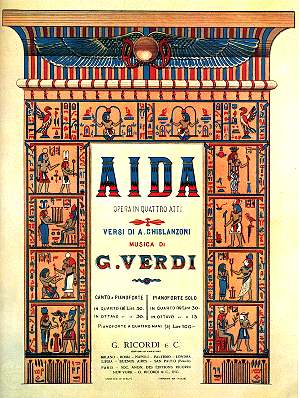
Set to a libretto by Antonio Ghislanzoni after Camille du Locle's French version of a scenario by Auguste Mariette
First performed in Cairo, Egypt, Opera House, on 24 December 1871
The cast at the premiere included Antonietta Pozzoni-Anastasi (Aida), Pietro Mongini (Radames), Eleonora Grossi (Amneris), and Francesco Steller (Amonasro).
Principle Roles
- Aida, Ethiopian princess enslaved in Egypt ...................soprano
- Radames, Egyptian Captain of the Guards ..................tenor
- Amneris, Egyptian princess ............................................mezzo-soprano
- Amonasro, King of Ethiopia, Aida's father ...................baritone
- Ramfis, Chief Priest of Isis ...............................................bass
- Il Re D'Egitto, The King of Egypt, Amneris' father .....bass
- Un Messaggero, a Messenger .........................................tenor
- Una Sacerdotessa, The High Priestess ........................soprano
 The Story
Notable Incipits
- "Celeste Aida" (Radames)
- "Ritorna vincitor" (Aida)
- "O patria mia" (Aida)
- "O terra addio" (Aida & Radames)
Recommended Recordings
- Caballe (Aida), Domingo (Radames), Cossotto (Amneris)
- Callas (Aida), Tucker (Radames), Barbieri (Amneris)
- Nilsson (Aida), Corelli (Radames), Bumbry (Amneris)
- October/November 2008 - London (English National Opera)
- March 2009 - Buenos Aires (Colon)
- May 2009 - Dresden (Staatsoper)
- June 2009 - Munich (Staatsoper)
- June 2009 - Vienna (Staatsoper)
- June/July 2009- Milan (La Scala)

No comments:
Post a Comment